The quick answer
For every tank, over any period (a shift, a day), the sum is the same:
Variance = actual closing dip − expected closing stock
A negative variance is a dip loss; a positive one is a dip gain. Do this for every tank at every shift close. A single bad number can be a measurement slip. A pattern is information.
What a dip reading is
A dip reading measures the depth of fuel in an underground tank using a calibrated dip rod. The tank's dip chart (its calibration table) converts that depth into litres. Water at the bottom of a tank is checked separately with water-finding paste.
Take a dip when a shift opens, when it closes, and before and after every delivery. The three numbers you need around it come from other places: opening stock is last shift's closing dip, deliveries come from the delivery note, and metered sales come from the nozzle meter readings for every nozzle drawing from that tank.
A worked example
These numbers are illustrative, not typical results.
| Opening stock (last closing dip) | 12,000 L |
| + Delivery received | 8,000 L |
| − Metered sales (all nozzles on this tank) | 9,500 L |
| Expected closing stock | 10,500 L |
| Actual closing dip | 10,380 L |
| Variance | −120 L (a dip loss) |
| As a share of sales | 1.26% |
| Value at an illustrative Rs 265 per litre | Rs 31,800 |
On its own, that is a question to ask, not a verdict. Repeated every shift, it becomes a trend line, and a trend is how a slow leak or a habitual short measure gets caught.
Dip variance calculator
Why variance happens
These are the common categories, not a diagnosis. Work through them in order, cheapest to check first.
1. Recording and measurement
- A mis-keyed opening or closing meter reading, or a nozzle left out of the sum.
- A dip taken on a tank that was not level or had just been delivered into, or read against the wrong dip chart.
- A sale booked against the wrong tank or product.
2. Metering
- A nozzle meter that is out of calibration. One that under-registers makes stock fall faster than sales explain (a loss); one that over-registers does the opposite (a gain).
3. Deliveries
- A decanting gap: the difference between what the delivery note says and what the tank actually received. Dipping before and after every delivery is how you measure it.
- A delivery that was received but not recorded, or recorded against the wrong tank.
4. Physical causes
- Temperature and evaporation, which move the real volume slightly.
- A genuine leak in the tank, a line or a fitting.
5. Deliberate causes
- Fuel taken and not rung up, or sales recorded short. A steady, repeated daily drain at similar volume is the classic signature.
Gains count too. Persistent dip gains are as worth chasing as losses: they can point to a meter that over-registers (customers getting less than they pay for) or deliveries being recorded short.
A daily routine that works
- Open the shift with a dip and the meters.Take a dip on every tank and write down every nozzle's opening meter. Lock these in; they should not change later.
- Dip around every delivery.Dip before and after, and compare the difference with the delivery note.
- Close with a dip and the meters.Closing dip on every tank, closing meter on every nozzle.
- Do the sum, per tank.Expected closing stock, actual dip, variance in litres and as a share of sales.
- Investigate against your baseline.Judge each tank against its own normal range, not a generic number.
- Watch the trend.The same small drain every day adds up. Look at a week, not just last night.
How PetroBind does it
- Opening meters and dips lock the moment a shift starts, so they can never be quietly edited later.
- Expected cash and dip gain or loss compute live as the shift closes, with a checklist to find the cause.
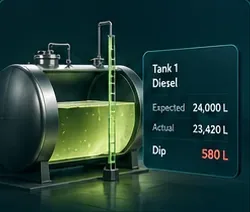
- Tank Monitoring tracks expected vs actual dip tank by tank, with a live 3D view. A closing dip does not just report loss: it adjusts fuel inventory in your books automatically.
- Purchases and Deliveries includes decanting-gap checks.
- AI Insights flags a tank that is quietly drained the same way for days, the slow leak that is easy to miss by eye.
- Dip Gain/Loss is one of the twelve built-in reports, exportable to Excel or CSV.
Choosing software? Start with what petrol pump software should do.
Frequently asked questions
How often should I dip my tanks?
A common practice is to dip every tank at the start and end of every shift, and before and after every delivery. More frequent dips make a slow leak easier to spot because the daily pattern is clearer.
What is an acceptable dip loss?
There is no single number. Allowances depend on the product, throughput, tank condition, how you measure, and what your OMC agreement or the regulator specifies. Track your own baseline for each tank and investigate when it moves.
Is a dip gain good news?
Not necessarily. More fuel in the tank than your books expect can come from a meter that over-registers, a delivery recorded short, a dip or chart error, or temperature effects. A consistent gain deserves the same attention as a loss.
Can software replace dipping?
No. The dip is the physical check. Software makes sure that dip is compared with expected stock every time, and keeps the history. Automatic tank gauges automate the measurement itself; see our guide to OGRA's digitalisation drive.
What is the difference between a leak and a dip loss?
A dip loss is the number: actual stock is lower than expected. A leak is one possible cause. Meter error, a mis-keyed reading, a decanting gap, evaporation and theft all produce the same number, which is why you investigate rather than assume.